Thailand Transportation 2026 - Taxi Grab Train Bus..
Getting around Thailand is relatively inexpensive compared with many Western countries, but transportation costs can vary significantly depending on where you are travelling, the distance, the type of vehicle and whether you are travelling during peak hours.
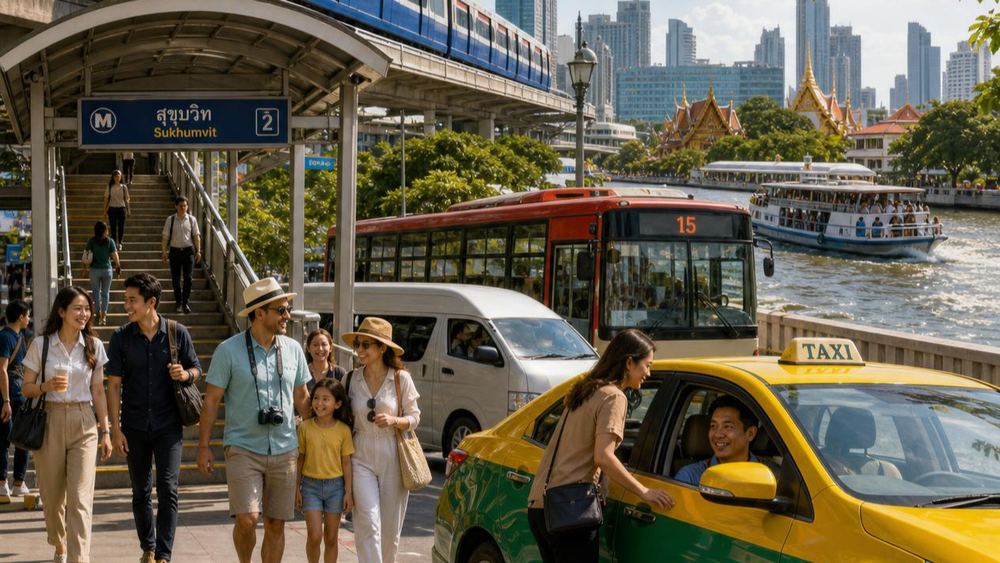
Thailand has an extensive transportation network that includes taxis, Grab, motorcycle taxis, tuk-tuks, BTS SkyTrain, MRT, Airport Rail Link, intercity trains, buses, minivans, ferries and long-tail boats.
For tourists, the challenge is often not finding transportation but deciding which option provides the best combination of price, convenience, comfort and travel time.
A short taxi ride may cost only a few dozen baht, while an inter-island ferry can cost several hundred baht. In Bangkok, a BTS or MRT journey can be much faster than a taxi during rush hour, while in islands such as Phuket, Koh Samui and Koh Phi Phi, taxis, private transfers and boats become much more important.
This guide explains the major transportation options in Thailand and provides approximate 2026 prices to help you plan your travel budget.
Important: Transportation prices can change. Taxi meters are regulated, while Grab and other app-based services use dynamic pricing. Ferry, bus and private-transfer prices also vary by route, operator and season. Always check the current price before travelling.
Thailand Transportation Costs at a Glance
Here is a quick overview of typical transportation costs.
Transportation | Typical Cost | Best For |
|---|---|---|
Bangkok taxi | From about ฿35 | Short city journeys |
GrabCar | Often ฿80–฿300+ | Convenient point-to-point travel |
GrabBike | Often ฿30–฿150+ | Solo travellers, traffic |
Motorcycle taxi | About ฿15–฿100+ | Very short trips |
Tuk-tuk | Often ฿80–฿300+ | Short tourist trips/experience |
BTS SkyTrain | Roughly ฿17–฿65 | Bangkok city travel |
MRT | Roughly ฿14–฿45+ | Bangkok city travel |
Airport Rail Link | About ฿15–฿45 | Suvarnabhumi–Bangkok |
Local bus | Often ฿8–฿30+ | Budget travel |
Intercity bus | About ฿100–฿1,000+ | Travel between provinces |
Ordinary train | From very low fares | Budget/intercity travel |
Sleeper train | Roughly ฿500–฿2,000+ | Overnight journeys |
River boat | About ฿10–฿40+ | Bangkok riverside |
Island ferry | Roughly ฿300–฿1,000+ | Island travel |
Long-tail boat | Roughly ฿200–฿2,000+ | Local sightseeing/private trips |
These are planning ranges rather than guaranteed prices. A route's exact price can differ substantially.
1. Bangkok Taxi Costs
Bangkok's traditional metered taxis remain one of the most affordable ways to travel around the city.
Official Bangkok taxi information lists a starting fare of approximately ฿35 for small taxis, with distance-based rates increasing as the journey gets longer. The government taxi-rate information also specifies ฿3 per minute when the vehicle is stationary or moving at no more than 6 km/h, which becomes particularly relevant in Bangkok traffic.
A typical structure is:
Distance | Approximate Meter Rate |
|---|---|
First 1 km | ฿35 |
1–10 km | ฿6.50/km |
10–20 km | ฿7/km |
20–40 km | ฿8/km |
40–60 km | ฿8.50/km |
60–80 km | ฿9/km |
Over 80 km | ฿10.50/km |
There can also be additional charges in specific situations.
For example, official government information states that taxis booked through a communication/electronic booking system can have an additional ฿20 service charge, while airport taxis waiting at designated airport taxi areas can have a ฿50 airport surcharge.
Is a Bangkok taxi cheap?
Yes, especially for two or more people travelling together.
A 5–10 km journey can often be considerably cheaper than travellers expect, although traffic can increase the final fare because the meter also accounts for very slow or stopped traffic.
Taxi vs BTS/MRT
During rush hour, however, a taxi that costs ฿100 may take 45–60 minutes, while a BTS or MRT journey costing ฿30–฿50 may take only 15–25 minutes.
Tip: For Bangkok sightseeing, consider taking BTS/MRT for the main part of your journey and a taxi or motorcycle taxi for the final few kilometres.
2. Grab in Thailand
Grab is extremely useful for tourists because you can enter your destination in the app, see the available transportation options and receive an estimated fare before confirming the trip.
Grab's official Thailand service includes GrabTaxi and other transportation options. GrabTaxi currently lists booking fees that can range from ฿20 for instant booking to ฿45 for advance booking, depending on the service and circumstances.
Typical Grab prices
Grab prices are not fixed like a traditional taxi meter. They can change depending on:
Time of day
Traffic
Weather
Demand
Distance
Driver availability
Location
Vehicle category
As a general Bangkok planning guide, you might encounter:
Trip | Approximate GrabCar Cost |
|---|---|
Very short trip | ฿60–฿100+ |
5 km | ฿90–฿160+ |
10 km | ฿130–฿220+ |
15 km | ฿180–฿300+ |
Longer airport/city journeys | ฿300–฿600+ |
These are illustrative planning ranges, not fixed Grab tariffs. Current 2026 travel references show similar Bangkok ranges, while noting that surge pricing can apply during peak hours and rain.
Why tourists prefer Grab
Grab can be particularly useful when:
You don't speak Thai
You don't know the destination address
You don't want to negotiate
You are travelling with luggage
You want GPS tracking
You want a digital record of the trip
You want to pay through the app
When traditional taxis may be cheaper
For short journeys with light traffic, a metered taxi can sometimes be cheaper than Grab.
For example, if a taxi meter shows ฿70 while Grab quotes ฿130 because of high demand, the traditional taxi is obviously cheaper.
Best strategy: Check Grab first, then compare the quoted price with your expected taxi fare.
3. Motorcycle Taxis
Motorcycle taxis are one of Bangkok's most practical solutions for short journeys.
They are particularly useful when traffic is heavily congested because motorcycles can move through traffic much more easily than cars.
Typical short-trip prices may range from approximately:
฿15–฿100+
depending on distance and location.
Motorcycle taxis are commonly found near:
BTS stations
MRT stations
Shopping centres
Residential areas
Office districts
Soi entrances
They are particularly useful for the "last kilometre" between a train station and your hotel.
Should tourists use motorcycle taxis?
They can save substantial time, but they are less suitable for:
Large luggage
Families with young children
Travellers uncomfortable on motorcycles
Rainy weather
Safety should always be the priority.
4. Tuk-Tuk Prices in Thailand
The tuk-tuk is one of Thailand's most recognisable forms of transportation.
Unlike a metered taxi, tuk-tuk fares are normally negotiated before the journey.
Typical tourist fares might be around:
฿80–฿300+ for a short journey
but prices can be considerably higher in heavily tourist-oriented locations.
The price depends on:
Distance
Location
Time
Traffic
Number of passengers
Tourist demand
Your negotiation skills
Are tuk-tuks cheaper than taxis?
Usually, not necessarily.
Tuk-tuks are often more expensive than a metered taxi for the same distance.
Many tourists nevertheless use them because the experience itself is part of visiting Thailand.
Tuk-tuk tip
Agree on the total price before getting inside.
If the driver proposes an unusually low price, ask whether there are any stops or conditions attached.
5. BTS SkyTrain Bangkok
The BTS SkyTrain is one of the best transportation options for tourists staying in central Bangkok.
It connects important areas including:
Sukhumvit
Siam
Chit Lom
Phrom Phong
Thong Lo
Ekkamai
Asok
Silom
Chatuchak area
Riverside connections
The official BTS route and fare system provides journey-specific fare information.
Current adult fares can reach approximately ฿65 on the BTS Green Line, depending on the journey and applicable extensions. BTS also introduced promotional travel packages for 2026–2027, with certain package arrangements offering lower effective fares.
BTS cost estimate
A tourist can generally budget:
฿17–฿65 per journey
depending on the route.
Why use BTS?
BTS is excellent during:
Morning rush hour
Evening rush hour
Major shopping trips
Central Bangkok sightseeing
It avoids much of Bangkok's road congestion.
6. MRT Bangkok
The MRT system complements the BTS and reaches areas that are not directly served by the SkyTrain.
The MRT Blue Line is particularly useful for tourists visiting areas around:
Chinatown
Hua Lamphong
Chatuchak
Sukhumvit
Asok
Silom
Sanam Chai
Old Bangkok connections
Current fare information indicates that the MRT Blue Line generally ranges from approximately ฿17 to ฿45, depending on distance, while the Purple Line has a separate fare structure.
BTS vs MRT
They are separate systems, so changing between them may require paying another fare unless a particular integrated arrangement applies.
For tourists, however, the combination of BTS + MRT provides excellent coverage of central Bangkok.
7. Airport Rail Link
The Airport Rail Link connects Suvarnabhumi Airport (BKK) with Bangkok.
It is often one of the cheapest and fastest options for travellers staying near the railway/BTS/MRT network.
A typical fare is approximately:
฿15–฿45
depending on the station.
For example, the Airport Rail Link can take passengers towards Phaya Thai, where they can connect to the BTS system.
Airport Rail Link vs Taxi
Option | Approx. Cost | Best For |
|---|---|---|
Airport Rail Link | ฿15–฿45 | Budget travellers |
Taxi | ฿300–฿500+ | Families/luggage |
Grab | ฿300–฿600+ | Convenience |
Airport bus | Around ฿60+ depending on route | Budget travellers |
Recent 2026 travel information puts the Airport Rail Link's maximum fare to Phaya Thai at about ฿45, while airport taxis involve the meter plus the applicable airport surcharge and potentially tolls.
Best option with luggage
If you have:
1 small suitcase → train can be excellent
Multiple large suitcases → taxi/Grab is usually easier
Family with children → taxi/Grab may be more convenient
Hotel far from rail → taxi/Grab may save time
8. Bangkok Public Buses
Bangkok's buses are among the cheapest forms of transportation.
Fares vary according to:
Bus type
Route
Air conditioning
Distance
Transport operator
Budget travellers can sometimes travel across parts of Bangkok for only a small number of baht.
Typical planning budget
Allow approximately:
฿8–฿30+ per journey
for many local bus journeys, although specific routes and services can cost more.
Buses are excellent for experienced travellers but can be more difficult for first-time tourists because:
Routes can be complicated
Stops may not always be obvious
Traffic can make journey times unpredictable
English information can be limited on some services
For tourists, BTS/MRT is generally easier where available.
9. Intercity Buses in Thailand
For travelling between cities, buses and coaches are often significantly cheaper than domestic flights.
Popular routes include:
Bangkok → Pattaya
Bangkok → Hua Hin
Bangkok → Chiang Mai
Bangkok → Chiang Rai
Bangkok → Phuket
Bangkok → Krabi
Bangkok → Ayutthaya
Typical intercity bus prices
Route Type | Approximate Price |
|---|---|
Bangkok → Pattaya | ฿150–฿250 |
Bangkok → Hua Hin | ฿200–฿400 |
Bangkok → Ayutthaya | ฿100–฿250 |
Bangkok → Chiang Mai | ฿500–฿1,000+ |
Bangkok → Phuket | ฿600–฿1,200+ |
Bangkok → Krabi | ฿600–฿1,200+ |
Premium VIP buses can cost more.
Prices vary considerably depending on operator, departure terminal, seat class and season.
10. Thailand Train Costs
Thailand's railway network is an excellent choice for travellers who want to experience the country more slowly.
The State Railway of Thailand operates services connecting Bangkok with destinations including:
Train prices depend heavily on:
Train type
Class
Air conditioning
Seat/berth
Distance
Express service
Ordinary trains
Ordinary trains can be extremely inexpensive.
For example, State Railway of Thailand information for the Wongwian Yai–Mahachai route lists ordinary adult fares of only ฿10 per trip, while air-conditioned service is listed at ฿25.
This demonstrates why local trains can be an excellent choice for budget travellers.
11. Overnight Sleeper Trains
Sleeper trains are particularly popular for:
Bangkok → Chiang Mai
and southern routes such as:
Bangkok → Surat Thani
A sleeper train can save the cost of one night's accommodation while allowing you to wake up at your destination.
Typical prices can range approximately from:
฿500 to ฿2,000+
depending on:
Class
Lower or upper berth
Air conditioning
Train type
Route
First-class private sleeper compartments can cost substantially more.
12. Ferries in Thailand
Ferries are essential for travelling between many Thai islands.
Important ferry destinations include:
Koh Samui
Koh Phangan
Koh Tao
Koh Phi Phi
Koh Lanta
Phuket
Koh Chang
Koh Samet
Prices vary significantly depending on the distance and type of vessel.
Typical ferry budget
For many tourist routes:
฿300–฿1,000+ per person
is a reasonable planning range.
Fast ferries, speedboats and combined ferry + transfer packages can cost considerably more.
13. Chao Phraya River Boats
Bangkok's Chao Phraya River is not just a tourist attraction—it is also a practical transportation route.
River boats can connect areas around:
Sathorn
Wat Arun
Wat Pho
Grand Palace
Chinatown
Riverside hotels
Some services are inexpensive, while tourist-oriented services cost more.
For budget planning, allow approximately:
฿10–฿40+ per journey
depending on the service.
The river can also be a great way to avoid Bangkok road traffic.
14. Long-Tail Boats
Long-tail boats are particularly common in:
Bangkok canals
Phuket
Krabi
Koh Samui
Phi Phi Islands
Floating markets
Rural waterways
Prices vary enormously.
A shared short trip may be relatively inexpensive, while a private charter can cost hundreds or thousands of baht depending on duration and location.
Always establish whether the quoted price is:
Per person
Per boat
One way
Round trip
For a fixed period
before agreeing.
15. Transportation Costs in Popular Tourist Destinations
Transportation prices outside Bangkok can be very different.
Phuket
Phuket is notorious for having higher transportation costs than Bangkok.
Tourists commonly use:
Grab
Bolt
Local taxis
Airport transfers
Songthaews
Motorbike rentals
Private drivers
A short taxi or app-based ride can easily cost more than an equivalent journey in Bangkok.
Pattaya
Pattaya has several inexpensive options.
Common transportation includes:
Baht buses/songthaews
Motorbike taxis
Grab
Bolt
Taxis
Private transfers
The baht bus is particularly useful for short journeys around central Pattaya.
Chiang Mai
Chiang Mai offers:
Songthaews
Grab
Tuk-tuks
Motorbike taxis
Local buses
Private drivers
Songthaews can be a very economical option, particularly when shared.
Koh Samui
Koh Samui transportation tends to be more expensive than Bangkok.
Options include:
Songthaews
Taxis
Grab
Private transfers
Motorbike rental
Airport transfers can be particularly expensive relative to Bangkok city transportation.
Krabi
Krabi transportation includes:
Songthaews
Grab
Taxis
Airport transfers
Long-tail boats
Ferries
Speedboats
If your destination is Railay Beach, for example, a boat is an important part of the journey.
16. Thailand Transportation Cost Comparison
For a tourist trying to decide what to use, this is the simplest comparison:
Transport | Price | Convenience | Speed | Tourist Friendly |
|---|---|---|---|---|
BTS | ⭐⭐⭐⭐⭐ | ⭐⭐⭐⭐ | ⭐⭐⭐⭐⭐ | ⭐⭐⭐⭐⭐ |
MRT | ⭐⭐⭐⭐⭐ | ⭐⭐⭐⭐ | ⭐⭐⭐⭐⭐ | ⭐⭐⭐⭐⭐ |
Taxi | ⭐⭐⭐⭐ | ⭐⭐⭐⭐⭐ | ⭐⭐⭐ | ⭐⭐⭐⭐ |
Grab | ⭐⭐⭐ | ⭐⭐⭐⭐⭐ | ⭐⭐⭐ | ⭐⭐⭐⭐⭐ |
Motorcycle taxi | ⭐⭐⭐⭐⭐ | ⭐⭐⭐ | ⭐⭐⭐⭐⭐ | ⭐⭐⭐ |
Tuk-tuk | ⭐⭐ | ⭐⭐⭐⭐ | ⭐⭐⭐ | ⭐⭐⭐⭐ |
Bus | ⭐⭐⭐⭐⭐ | ⭐⭐⭐ | ⭐⭐ | ⭐⭐⭐ |
Train | ⭐⭐⭐⭐⭐ | ⭐⭐⭐⭐ | ⭐⭐⭐ | ⭐⭐⭐⭐ |
Ferry | ⭐⭐⭐ | ⭐⭐⭐⭐ | ⭐⭐⭐⭐ | ⭐⭐⭐⭐⭐ |
Private transfer | ⭐⭐ | ⭐⭐⭐⭐⭐ | ⭐⭐⭐⭐ | ⭐⭐⭐⭐⭐ |
17. How to Save Money on Transportation in Thailand
There are several simple ways tourists can significantly reduce transportation expenses.
1. Use BTS/MRT in Bangkok
Avoid taxis during rush hour whenever possible.
2. Compare Grab with taxi meters
Don't automatically assume Grab is cheaper.
3. Travel as a group
A ฿300 Grab ride split between four people costs only ฿75 each.
4. Use airport trains
If your hotel is close to a train station, the Airport Rail Link can save considerable money.
5. Use local buses
They are excellent for experienced budget travellers.
6. Avoid unnecessary private transfers
Private airport transfers are convenient but can be significantly more expensive.
7. Check ferry packages
Some operators offer combined:
Ferry + minivan + hotel transfer
packages.
These can sometimes be more convenient than arranging every segment separately.
8. Avoid peak demand
Grab and other app-based transportation services may become more expensive during:
Heavy rain
Rush hour
Major events
Holidays
Late-night demand
Airport peaks
18. Thailand Transportation Scams Tourists Should Avoid
Transportation scams are not unique to Thailand, but tourists should remain alert.
Common problems include:
Taxi refusing the meter
Ask the driver to use the meter. If they refuse, consider another taxi or an app-based service.
Unusually cheap tuk-tuk rides
An extremely cheap ride may sometimes involve unwanted stops at shops or tourist businesses.
Unclear boat pricing
Always clarify whether the price is per passenger or per boat.
Unlicensed airport drivers
Use official airport transportation areas or reputable ride-hailing services.
Changing prices after departure
Agree on a fare before using transportation where the price is not metered or displayed in an app.
19. Cash or Card?
Thailand is increasingly digital, but tourists should still carry some cash.
Cards and mobile payments are widely accepted in:
Shopping malls
Hotels
Major restaurants
Large businesses
Ride-hailing applications
Cash remains important for:
Street food
Local buses
Small shops
Markets
Some taxis
Small boats
Rural transportation
Small island businesses
Keeping ฿100–฿500 in small notes is often useful.
20. How Much Should Tourists Budget for Transportation?
Your daily transportation budget depends heavily on your travel style.
Budget traveller
฿100–฿250 per day
Possible if you primarily use:
Walking
Local buses
BTS/MRT
Shared transportation
Mid-range traveller
฿250–฿600 per day
Suitable for travellers combining:
BTS/MRT
Occasional taxi
Grab
Boats
Comfort traveller
฿600–฿1,500+ per day
Possible if using:
GrabCar
Taxis
Private transfers
Tours
Boats
Families
Families may find private cars or Grab more economical than buying four separate train tickets, particularly when travelling with children and luggage.
21. What Is the Cheapest Way to Travel Around Thailand?
There isn't one answer for the entire country.
Generally:
Within Bangkok:
BTS, MRT and local buses are among the cheapest practical options.
Between Thai cities:
Ordinary trains and buses can be very economical.
Overnight:
Sleeper trains can provide transportation plus overnight accommodation.
Between islands:
Ferries are generally cheaper than private speedboats.
For short Bangkok journeys:
A metered taxi can be very inexpensive.
For groups:
Grab or private transportation can become surprisingly economical when the cost is divided among several passengers.
22. Best Transportation Option for Different Travellers
Solo traveller
Use:
BTS
MRT
Motorcycle taxi
GrabBike
Local buses
Couple
Use:
BTS/MRT
Taxi
GrabCar
Ferries
Family with children
Use:
GrabCar
Taxi
Private transfers
BTS/MRT where convenient
Backpacker
Use:
Local buses
Trains
Shared vans
Ferries
Ordinary trains
Luxury traveller
Use:
Private driver
Airport transfer
Premium vehicles
Private boats
23. Final Thailand Transportation Budget Guide
Thailand remains one of the easier countries in Southeast Asia for travellers to explore without spending a fortune on transportation.
The key is to choose transportation according to the situation rather than relying on one method.
Use BTS/MRT when Bangkok traffic is heavy.
Use taxis for inexpensive door-to-door journeys.
Use Grab when you want convenience and a price displayed before booking.
Use trains and buses for economical intercity travel.
Use ferries to move between islands.
Use tuk-tuks for the experience rather than assuming they are the cheapest option.
For a typical tourist, transportation may represent only a modest part of the overall Thailand travel budget. However, airport transfers, island transfers and private transportation can quickly increase costs, so planning these journeys in advance can make a significant difference.
Most importantly, don't judge transportation only by the ticket price. A ฿40 train ride that requires two additional taxis may ultimately cost more than a ฿150 direct journey. Consider the total cost, travel time, luggage, comfort and convenience before choosing.
2026 Price Disclaimer
Transportation fares in Thailand can change because of government fare adjustments, fuel prices, operator policies, seasonal demand, special promotions and dynamic pricing. The figures in this guide are intended as general 2026 travel-budget estimates, not guaranteed quotations. Bangkok BTS publishes route-specific fares through its official fare system, while Grab displays the applicable fare before booking.
Quick FAQ: Thailand Transportation
Is transportation expensive in Thailand?
Generally, no. Local buses, trains and Bangkok's mass-transit systems are relatively inexpensive. Private taxis, Grab rides and island transportation can cost considerably more.
Is Grab cheaper than taxis in Thailand?
Not always. A metered taxi can be cheaper for short journeys, while Grab provides convenience and upfront pricing. Compare the two whenever practical.
How much is a taxi in Bangkok?
Bangkok metered taxis start at approximately ฿35 for small taxis, with distance-based charges thereafter. Additional charges can apply in specific situations.
How much does BTS cost in Bangkok?
Depending on the route, BTS fares can range from approximately ฿17 to ฿65 for adult journeys on the relevant network. Check the official BTS fare calculator for the exact journey.
How much does MRT cost in Bangkok?
The MRT Blue Line currently costs approximately ฿17–฿45, depending on distance.
Is Bangkok public transportation better than taxis?
For many journeys during rush hour, yes. BTS and MRT avoid much of the city's road congestion.
How much should I budget for transportation in Thailand?
A budget traveller may manage with around ฿100–฿250 per day, while a mid-range traveller may spend approximately ฿250–฿600. Families and travellers using private cars can spend considerably more.
What is the cheapest transportation in Thailand?
Local buses and ordinary trains are among the cheapest options, while BTS/MRT provide excellent value for travelling around Bangkok.